
Flag of Sápmi
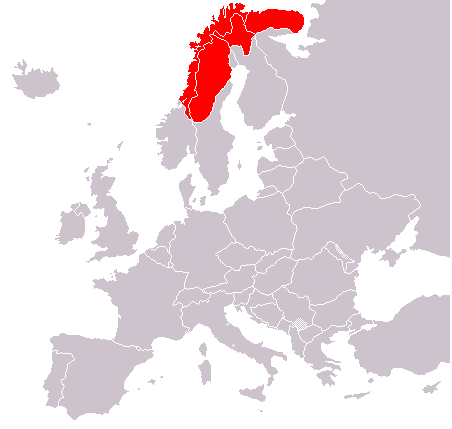
Sápmi appears in red
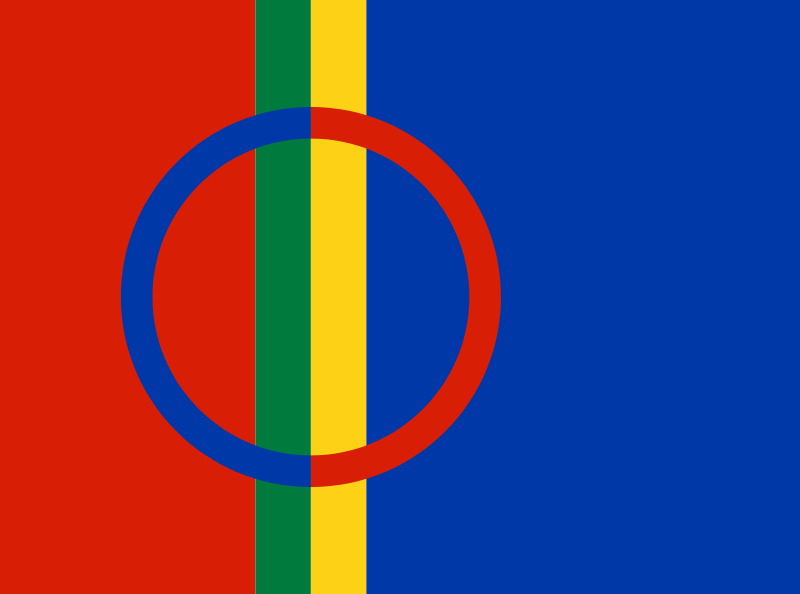
The flag of Sápmi (or Lapland) was adopted on 15 August 1986 at the 13th Nordic Sami Conference in Åre, Sweden.
Sápmi lies mostly within the Arctic Circle, stretching through northern Norway, Sweden, Finland and Russia’s Kola Peninsula.
Designed by Astrid Båhl, the flag defeated over 70 other designs in a competition.
It then replaced the unofficial – more minimalist – Synnøve Persen design from 1977.
Båhl and Persen both feature red, yellow and blue in their designs.
Gákti, the traditional Sami ceremonial and working garment, commonly use these three colours.
In addition, South Sápmi Gákti feature green, hence the inclusion of this colour by Båhl.
Båhl also includes a circle, half in blue (the Moon) and half in red (the Sun).
The Sami national anthem refers to them as ‘offspring of the sons of the Sun’.
Sami National Day is 6 February.
In 2003 Norway granted official status to the Sami flag, so all Norwegian municipalities must fly the flag on that date.
Bonus fact: The Persen flag formed part of the protest movement against the Alta Hydroelectric Power Station, which opened in 1987.
Author: Alex Crouch (Flag Institute accredited journalist 2015/16).